Sustainability for luxury and everyday homes in 2026.
— 05 March 2026
Old browser alert! We have detected you are using a pretty old browser. This website uses cool features that can't be supported by your browser.
If we let you see the website it would look all weird and broken, nobody wants that!
Update your browser!— 05 March 2026
Sustainability in 2026 is no longer a niche consideration — it is fundamental to how we design and build. Right across the country, sustainable materials are shaping both high-end residential projects and everyday refurbishments.
One of the most significant shifts is the growing use of low-embodied carbon materials. Timber construction — particularly FSC-certified and locally sourced timber — continues to lead. Here in Devon, where forestry is part of the regional economy, using responsibly managed British timber reduces transportation emissions whilst simultaneosly supporting local supply chains. Exposed timber frames, once considered rustic, are now celebrated in contemporary luxury homes for their warmth and architectural clarity.
Alongside timber, we are seeing a revival of lime-based materials. Lime plasters and renders are especially suited to the south-west’s historic building stock. Unlike cement, lime is breathable, flexible, and far more compatible with older stone and cob structures common across Devon and Cornwall. Beyond performance, lime offers a beautiful, softly textured finish that aligns perfectly with the growing demand for tactile, natural interiors.
Reclaimed and recycled materials are also becoming mainstream. Salvaged stone, reclaimed brick, and repurposed timber beams introduce character while significantly lowering embodied carbon. In coastal environments, where weathering is part of the landscape, materials that age gracefully — untreated timber cladding, natural stone, zinc — offer both durability and aesthetic depth.
Clients are increasingly seeking eco-conscious luxury in our higher end projects . This means natural stone sourced responsibly, wool or plant-based insulation, clay paints free from VOCs, and high-performance glazing systems that dramatically reduce operational energy. Luxury is being redefined: not as excess, but as quality, longevity, and environmental responsibility.
Equally important are modern methods of construction. Prefabrication, off-site manufacturing, and panelised timber systems reduce waste and improve build efficiency — particularly valuable in the remote or coastal sites we regularly see, where logistics can be challenging.
Ultimately, sustainability is not about a single product or finish. It is about a holistic approach: selecting materials with transparent supply chains, designing for longevity, and ensuring buildings perform efficiently over time.
CASE STUDY: GORWOOD HOUSE
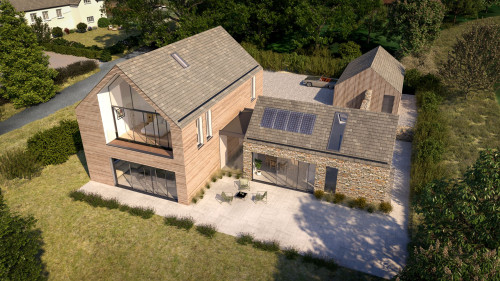
A current example of this approach can be seen in Gorwood House, a contemporary rural home in the Devon countryside. Due to complete in April 2026, the project demonstrates how sustainable materials can be integrated into a high-quality residential scheme without compromising architectural ambition. The design embraces a palette of natural, durable materials that sit comfortably within the landscape, combining modern methods of construction with carefully detailed contemporary forms. Timber plays a central role in the material strategy, both structurally and visually, helping to reduce the building’s overall carbon footprint while providing warmth and texture to the architecture.
Alongside timber, the house incorporates natural finishes and high-performance building components to improve both environmental performance and longevity. Materials have been selected for their durability and ability to weather gracefully within the exposed rural setting, ensuring the building will age naturally over time rather than require frequent replacement. High levels of insulation, carefully positioned glazing and a fabric-first design approach help minimise operational energy demand. The project illustrates how sustainable material choices — combined with thoughtful design — can deliver a form of contemporary luxury rooted in quality, environmental responsibility and a strong connection to place.